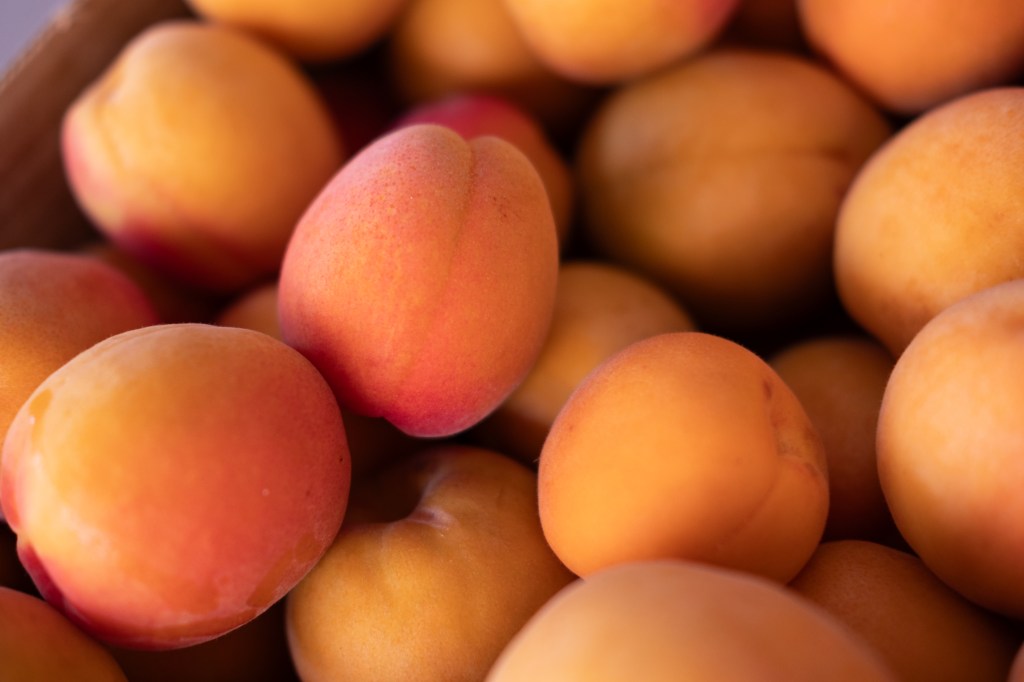
Canada grows very few apricots. Yet the few it does produce have become the source of an accent curiosity. The fruit itself is not going extinct but the way we say it, might be.
Every year around Canada Day, the buying, selling and eating of that rumpy fruit pushes people to utter the word apricot.
How did you pronounce “apricot” just now? Was it APE-ricot or APP-ricot?
In the small corner of Canada where apricots are grown, the most common pronunciation seems to be APE-ricot.
There isn’t a definitive study in Canada on the APP-ricot versus APE-ricot divide but in the United States there is and we can take some clues from it.
The Harvard Dialect Survey looked at differences in pronunciation and usage of numerous words from soda to chesterfield to apricot. Josh Katz, a grad student at North Carolina State University in 2013, using the survey data, produced heat maps which illustrate the geographic distributions. He did one for APP-ricot versus APE-ricot, as seen below.

It turns out that across the continental United States there is a lot of variation. Most Utahns for example, say APE-ricot. With increasing distance from Utah there’s a tipping point at which 50% of people say APE-ricot and 50% say APP-ricot. Look closely and you see there is a band of that ambiguous 50/50 mix which extends right up into the southern interior of British Columbia. Assuming the Harvard data can be extrapolated northward, we can conclude that everyone in Canada says APP-ricot, except for those in the southern interior of BC where roughly half say APE-ricot.
Having lived in the southern interior’s Okanagan Valley most of my life, I can confirm that many locals do indeed say APE-ricot. That includes me. But some also say APP-ricot.
In fact, it seemed rare to hear APE-ricot in early summer this year. Perhaps the large number of APP-ricot speaking tourists who overwhelmed the local theatre of sound, left me with the impression that APE-ricot had disappeared?
To my great delight on Canada Day, I stopped in at A&B Fruit Market, 13 kilometres north of Osoyoos, to buy apricots fresh from their trees and was greeted by a Portuguese woman in her sixties named Manuela. With a grand voice and welcoming smile, and without prompting, she referred to the fruit as APE-ricots. She was to me, like a long-lost family member in the desert at night, recognizable by sound alone.
And so it all makes one wonder, if APE-ricot is so rare across Canada why has it not been eliminated from its last holdout in BC’s interior by the more common APP-ricot?
This pocket of British Columbia—the Okanagan Valley, the Similkameen Valley and even the Kootenays to some extent—is quite likely the only place in Canada where you will hear APE-ricot being spoken. The truth is, APE-ricot probably has the upper hand in this struggle for accent supremacy. It boils down to climate, confidence, history and fruit stands.
British Columbia grows 90% of all the apricots in Canada and almost all of those come from the dry southern interior where conditions are ideal—mild winters, intense early heat in spring, and a sophisticated irrigation network. As far as commercial production is concerned, the Okanagan and nearby valleys are pretty much the whole show.
But the whole show is tiny.
According to the 2021 BC Tree Fruit Acreage and Maturity Report, there were 13,000 acres in fruit production across the entire province. Of the 13,000 acres in grapes, apples, cherries, plums, peaches, nectarines and pears, there were only 52 acres of apricots in the Okanagan valley and another 24 acres in the neighbouring Similkameen valley. A few more acres were scattered elsewhere but overall apricots accounted for less than 1% of total fruit production in all of British Columbia.
Even worse, apricot acreage decreased by 4% from 2011 to 2021. Details are unknown but if an orchardist had taken down a few apricot trees to make room for a new barn or outbuilding, that would have been enough to account for the 4% loss. In other words, apricots have such a miniscule influence on Canadian agriculture that one would hardly think they have any influence at all. Yet, they do.
They are a marker of regional linguistic identity.
How did that happen?
Well, there is an unspoken rule among those who grow, sell, process, distribute and market a product—they get to tell others how to “correctly” pronounce the name of the product. Since the Okanagan and Similkameen valleys have virtually all the apricots grown and processed in the country, APE-ricoters have a confident upper lip over the APP-ricoters whenever they speak, especially when selling directly at roadside fruit stands.
This linguistic enforcement has history behind it. The earliest settlers, especially in the South Okanagan around Oliver and Osoyoos where most of the apricots are grown, were of British origin. The first orchard was planted at Osoyoos in 1857 and the early purveyors of fruit could make stern announcements about “proper” pronunciation and of course, whenever they spoke, they said APE-ricot.
In the 1920s and 1930s a small but influential group of Hungarian immigrants arrived and soon took up orcharding. As they learned English from those around them, they copied the sound APE-ricot, not APP-ricot.
Then came a large number of Portuguese immigrants after the Second World War who pooled their resources, bought up many of the orchards and became a dominant force in the local agricultural industry. As they learned English, they too learned to say APE-ricot, not APP-ricot.
Meanwhile, there were also a significant number of Mormon orchardists. Since Utah Mormon English and British English both use APE-ricot, the pronunciation was further enforced.
South Asians are the latest immigrants who now own most of the orchards in the Southern Okanagan.
At the A&B fruit stand, I learned from Manuela that she originally bought the orchard from a Hungarian family and had, after many years of business, sold it to her South Asian friend.
Manuela’s friend, while sorting through the latest batch of Rainier cherries, preparing for display, mentioned that she came with her family from India over a decade ago and she too uses the APE-ricot pronunciation. She also reported that everyone at the packing house where fruit is sorted, boxed and shipped, says APE-ricot.
This pattern of dialect continuity is connected to what is known as the founder effect—the first small group of people who settle in a new region create the institutions, culture and language nuances upon which all others who come after, are shaped by that original group.
All of this is to say that the APE-ricot pronunciation has continued in the Okanagan Valley, which makes it a linguistic outlier compared to the rest of Canada.
There is however, a looming threat.
If the 76 acres of apricots were lost, for whatever reason, and there’s good reason to believe vineyards could replace them, there would be a decline in the number of people who would confidently enforce the APE-ricot pronunciation, leading to devastation in the linguistic terrain.
Any word not spoken regularly, especially in its unique regional way, is susceptible to being replaced by the accent monoliths of larger populations. With enough tourists from Vancouver, Alberta and beyond, APE-ricoters could be steamrolled into oblivion by the APP-ricoters.
So the next time you are out and about in the Okanagan or Similkameen valleys, listen for it. Even better, support the local dialect. Say, “APE-ricot.”
Photo: Jarusha Brown Photography / http://www.jarushabrown.com
 Mark Hecht